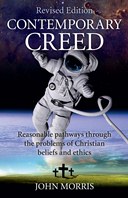
 Unlike Richard Dawkins, Contemporary Creed (revised edition) sees no conflict between evolution and God, faith and modern science. But what sort of God creates a violent universe with a Big Bang almost 14 billion years ago and appears to do little or nothing to prevent built-in suffering & natural disasters like earthquakes, famines, disabled children and cancers? The Christian God leaves a lot unexplained. Some writers give superficial answers whereas Morris, who helps care for his own handicapped grandson, gets to the root of difficulties and succeeds in finding credible pathways through sixty problems of Christian beliefs and ethics.
He writes for believers and unbelievers: for Christians like himself who admit their doubts, and for atheists and agnostics interested in big questions. His unusual format of 90% prose and 10% original poetry is entertaining, and the style straightforward everyday language, offering conclusions that are often open-ended, undogmatic. His systematic theology becomes a brief A-Z that may be read in any order for individual Bible study, or by house groups that want a provocative structure for lively discussion. Unlike Richard Dawkins, Contemporary Creed (revised edition) sees no conflict between evolution and God, faith and modern science. But what sort of God creates a violent universe with a Big Bang almost 14 billion years ago and appears to do little or nothing to prevent built-in suffering & natural disasters like earthquakes, famines, disabled children and cancers? The Christian God leaves a lot unexplained. Some writers give superficial answers whereas Morris, who helps care for his own handicapped grandson, gets to the root of difficulties and succeeds in finding credible pathways through sixty problems of Christian beliefs and ethics.
He writes for believers and unbelievers: for Christians like himself who admit their doubts, and for atheists and agnostics interested in big questions. His unusual format of 90% prose and 10% original poetry is entertaining, and the style straightforward everyday language, offering conclusions that are often open-ended, undogmatic. His systematic theology becomes a brief A-Z that may be read in any order for individual Bible study, or by house groups that want a provocative structure for lively discussion.
|
| Content of First Edition 2005 : Contemporary Creed translates ancient beliefs into today’s language. It is written for those who, like the author, do not find it easy to believe and whose faith is married to doubt, but he points an intelligent pathway through sixty intellectual problems of traditional Christian beliefs. A library of theology books is compressed into this novel and popular mini-course on modern Christianity, in transparent English, without jargon. Original verse helps animates old truths and solve their difficulties. |

Recent Reviews
| I have just finished reading the Revised Edition of Contemporary Creed and I congratulate you upon it. It is a remarkable book. It displays an impressive scholarship and human perception |
| Contemporary Creed (Revised Edition) by John Morris has probably been the most thought provoking book, apart from the Bible itself, which I have ever read. Almost all of the 60 questions raised are ones that have exercised me, and I found the 'Morris approach' and insights challenging in a very positive way. The book is a wonderful resource, with Bible references and cross-references for exploration of themes. I will be going back to it again and again for leads to follow. It would be great to have it in electronic form with hyperlinks to say, the NIV. Is it a book for everyone? The book reveals 'encounters' the author has had with people and philosophies of life: John Morris addresses his own questions, and those which arise from such encounters. It is a book for everyone willing to have their views challenged. Mine were, and I feel I am the better for it! Perhaps it could be said that John Morris 'comforts the afflicted and afflicts the comfortable.' Christians who have never really questioned things might find it disturbing in places. Fortunately, it is possible to select the question that you would like to explore first, and gain confidence in 'the author' through this. I find that the approaches to issues are thoughtful, sensitive and tentative, allowing the readers space to come, in the end, to their own conclusions. The book has a disconcerting depth to it. The author himself has come to terms with what many would regard as tragedy: that of a grandson, Daniel, who will never be able 'grow up' and daily presents challenging behaviour. The author does not shrink from the question of why-o-why the God in whom he believes, allows such suffering. He has a secret weapon in presenting both the questions and answers: poetry of his own composition. The deceptively simple verses reach the parts of consciousness that prose fails to penetrate. I know my further study of the book will be even more rewarding. I have said it is a deep book. It has a depth of research but it is accessible to all who have the will to explore. The author has a very special way of looking at what faith means in the contemporary world. The secret is that John Morris was 'in another existence' an English teacher and lecturer, and so is able to express complex arguments in a readable form. The insights from science are also included in formation and exploring answers to questions. This is indicative of how John Morris 'listens' to people. There are more than subtle differences between the first and this revised edition. The author has responded radically to some comments. In works of scholarship the writers tend to want to 'put down' other views to enhance their own. Many Christians can learn from the way John Morris 'listens' and reflect 'if we do not listen (and respect) others, how can we say we listen to God?' Some Christians might be worried about what the Creed at the front of the book omits. Read carefully what John Morris says about it. In presenting 'a creed' in this way it is designed to say what faith means to a believer in practical terms. It is worth remembering that the traditional creeds were not necessary for early Christians to have a living faith. A faith that swept through the Roman Empire and beyond. John Morris uses his Creed as a productive starting point in a quest to explore with a wide audience what faith can mean today. Finally, and perhaps most importantly, this is one to challenge those who feel themselves 'outsiders' to Christianity or perhaps antagonistic to all religious faith. John Morris succeeds in being inclusive, engaging with science and the arguments of people like Richard Dawkins. He tackles the issues of the computer/internet age in which we are assaulted by such a variety of faiths and philosophies. He resists the temptation to 'pick and mix', and most effectively puts the case for commitment to a faith in Jesus. For John Morris this 'Faith in Jesus' is both simple, but at the same time profound. Simple enough for it to have the potential to embrace anyone who is willing to consider the meaning of our existence on earth. Yet, profound enough for the greatest thinkers of our age. A Contemporary Creed indeed. |
|
Book Review Brockenhurst Magazine, Hampshire 'Contemporary Creed' by The Rev'd Dr John Morris We know John Morris from our days living near Winchester. Having subsequently lost touch we reconnected a couple of years ago when I found him in the audience for a talk I was giving about Emmaus Hampshire. He told me about the revised edition of 'Contemporary Creed' which was about to be launched. I bought a copy and have just finished reading it. His book is sub-titled 'Reasonable pathways through the problems of Christian beliefs and ethics'. In his Commendation the Archbishop of York, John Sentanu (once a pupil of John Morris), writes 'we need books to bridge the gap between belief and unbelief, between the Church and the enquirer who cannot find the entrance and, for that matter, between the pulpit and the pew'. This book does just that. There are nine sections in the book, beginning with 'God and Creation' and ending with 'Christian Living'. Sixty problems are addressed. Each starts with a poem by the author into which he distils the essence of the problem under discussion. There follows a brief commentary on the poem, couched in clear prose and laced with biblical references. It is truly contemporary and very accessible. It is also a multi-purpose book suitable for everyone from Non-Christians, through House Groups to School and College Religious Education teachers. John Morris has also made the Revised Edition available to read on line. I strongly and unreservedly recommend you to log in to www.contemporarycreed.org.uk and take a look for yourself. |
Published Endorsements
| The ethics section is extremely well written, of interest to a person like me, sceptical of organised religion. |
| Fair and open-minded, widely read in science, philosophy and theology, John Morris offers a vision of Christian belief and ethics which can stand convincingly in this modern world. Work right through it in a group with friends of differing convictions! It could enlarge and enrich all your lives. |
| Contemporary Creed blends science and theology and tunnels through difficulties in search of truth - not unlike my tunnelling microscope in search of atoms, both creating wonderful images. |
| As a scientist I appreciated the systematic and logical approach you adopted. |
| It builds on the original to create a valuable and more transparent guide for occasional churchgoers like me. |
| ’Faith requires us to live bravely with doubt and uncertainty.’ That pretty well sums up this unusual book, a defence of orthodox Christian faith that takes doubt seriously, and respects the hesitancy of the genuine searcher for answers. |
| Believers and non-believers will find a deep challenge to their beliefs in this revised edition, which builds on all the very appealing characteristics of the first. It is better the ’second time around’ - but still easy to read, with each page offering a stimulating encounter with the thoughts of a person of great faith, which has been tempered by experience. Dr. Morris knows science and faith are not competing but complementary. |
| As an atheist I find John Morris’s writing refreshingly non-preachy. |
| Dr. Morris combines considerable insight into religious faith with an acute liberal mind and the rare ability to communicate what he knows and has experienced in terms accessible to every seeker after truth. This is a unique book. |
| John Morris is one of those who experiences a God presence that he cannot define but who will not deny its reality. He writes with integrity, clarity and passion, as he explores spirituality with a contemporary accent. |
| In this enlarged edition, John Morris offers poetry and cogent commentary to expand the minds of uncertain Christians, open-minded seekers and principled antagonists of religion. Always honest, the author avoids neatly packaged answers in favor of intuitive and reasoned invitations to delve deeper into fundamental questions of God and the human condition. |
| This is a rich resource for the RE teacher. It is a creative and faith-based perspective on ultimate and moral questions. Dr Morris offers a real insight into his grappling with some of life's most difficult questions. It is not a book of easy answers but an engagement with controversial truth claims and moral positions. Thought-provoking stimuli for secondary RE range from imagined dialogue between theist and atheist, through poetic expression of belief, to critical theological exposition. I would encourage teachers and students to consider their own responses to his sixty ’problems’. There is plenty to choose from for those of us who enjoy a lively classroom discussion! |
| I thoroughly enjoyed the book’s mixture of good theology, ethics, and expressions from the heart of a doubting believer. Not only does it inform my own fragile faith, it can also help my students to write better essays. I heartily recommend it as one of the great works of theology. |
| John Morris sheds light on the Christian faith as a lived reality not simply a set of doctrines and ethics. The reader will encounter theology in a readable form and will be drawn into a discussion through the accessibility of the language and the provocation of the content. This book would be extremely useful for church discussion and confirmation groups. |
| A revised edition usually means 1) that the first edition was successful, and 2) that the author has developed his thinking. This book is no exception: it will continue to satisfy the demand for intelligent discussion of key problems surrounding Christian belief and practice. Morris - who is at home with the Big Bang and evolutionary biology - does this in an imaginative, undogmatic way, with sensitive treatment of natural disasters and moral evils. |
Endorsements since publication
School Heads of Religious Studies emailed John after his talks:
| Your talk was perfectly suited to pupils studying RS for any of the major exam boards at GCSE and A Level. At Harrow, we have just moved from Edexcel GCSE (study of Christianity and Islam: 5RS01 & 5RS08) to OCR Philosophy and Ethics B (B J621);
and at A Level we study Edexcel's Religious Studies (philosophy of religion & ethics). Your talk touched on a number of relevant topics: Good and Evil, The end of life, Religion & Science, Beliefs about deity and at A Level: The problem of evil & suffering and Arguments for the existence of God. I wholeheartedly recommend your lecture and I, and all of my students, were impressed by the way you delivered sensitive and thought-provoking material in a way that was totally relevant to the subject they are studying. |
| Many thanks for two very thought-provoking talks. I taught off the back of them for most of the day today! |
| Thank you so much for your visit. The boys did, indeed, find it very interesting and I am pleased so many bought a copy of your book [relevant to our] OCR specification at AS and A2 levels including: Arguments for the existence of God and counterarguments; The problem of evil; Ethical theories - Utilitarianism, Relativism, Christian Ethics, Kantian Ethics, Natural Moral Law; Miracles; Determinism & freewill. |
| Many of your points complemented our current A level course wonderfully. |
| Your book is of relevance to our GCSE and A Level students(OCR Philosophy B and Edexcel RS) |
| John Morris addressed over 100 6th formers who had chosen not to attend Chapel this Sunday. His consideration of the relationship between Christians and Atheists brought new light to the debates surrounding matters of faith, science and doubt. With distinct clarity and intellectual rigour, John broke down the various arguments of believers and non-believers and skilfully reworked them towards a contemporary creed; a creed applicable to all, and one that helps us understand challenges of faith in an era dominated by a desire for evidence and answers. John's talk is accessible to all yet challenging enough to force us to rethink the conclusions we thought we had reached. |
| This is a beautiful book and it has been a welcome addition to our departmental library; it is a resource that helps students connect with the many ways we may enquire and seek truths for ourselves. The questions explored within the book have helped our students, and their teachers, to find new routes into understanding what it means to believe and the reasonableness of those beliefs. |
| It really is an excellent read. Your book will be a great resource for confirmation classes. |
and other endorsements
| I have been dipping into your book, and find it very thought provoking - a mine of issues, arguments and reflections. I like the brief, concise format - ideal for a daily/occasional diet. |
| At last a book on Christianity I can understand and follow with confidence! Dr Morris surprises me: he does mention unpersuasive Old Testament ideas, but he also successfully links the New Testament to current scientific thought. As a reluctant atheist, I feel we are on firmer common ground where some significant issues are neatly resolved. |
| I have read Contemporary Creed and am greatly admiring of the scholarship, poems and commentary all of which seem to me to give new life to the Christian ministry. The recent spate of excellent tv programmes on space, asteroids etc has made us all think religiously and to realise that there are limits to our ability to grasp concepts. But it is amazing what we have discovered in the past 200 years. I think the cover of your book is a great image...I suppose we are like cats watching a tv programme, not really understanding but conscious of some of the content. I cannot see how how our minds will ever grasp the idea of infinity. Jesus' idealism is really liberal Judaism, inclusive - black, gay, lesbians, women, criminals - everyone. It does make for a super-idealism but we are gradually moving towards it. |
| All too often theology becomes detached from its context in the world as we actually experience it, and becomes a sort of three-card trick in which there is nothing of substance behind the intellectual sleight of hand. It is very invigorating to read a sincere attempt to find real answers to real problems. |
| I have read Contemporary Creed and have lent it to a couple of friends.They,like me, found it most helpful in trying to answer some of the more difficult questions of faith in our modern,scientific world. Actually it's much easier to be a Dawkins than it is to have a real faith that defies some of the science.For the latter you need imagination and commitment. I don't think many people realise that our Christianity is the basis of our civilisation and we behave by its precepts.There are no absolutes in human behaviour, and guidance through a faith is essential. |
| See also the review at |
| Your book looks excellent and just the sort of thing we want for increasing depth of intelligent discipleship |
| What a brilliant range of commendations! I love the fact that you have Martin Rees, Michael Green and John Humphrys. I will be happy to commend the book in the Diocese of Oxford |
| I was delighted to read that your book Contemporary Creed is now being catalogued and added to the House of Commons Library Holdings. Many congratulations. |
| Wow! A book for 'beggar to bishop', and everyone in between!
A huge task to undertake but superbly accomplished as John Morris tackles 60 oft-perceived stumbling blocks to Christian faith, and encourages readers to work through for themselves exactly what can be gleaned from an informed reading of the Bible. Each "problem" is accompanied by succinct verses of his own poetry which contain the nub of the answer, together with a short commentary, liberally sprinkled with biblical references, to enable the reader to have confidence in understanding what their own answers might be.
From asking whether evil can serve any useful function to whether it is possible to be a Christian and yet frequently doubt; or whether Christ's uniqueness would be undermined if Joseph had been his natural father (and 57 more!), the questions are straightforwardly and honestly tackled in a way that encourages imagination and interaction. And these are the real questions that are posed by Joe Public - those they would like answered, rather than the 'angels dancing on the head of a pin' theological depths.
This is not a book of pat answers but an acknowledgement of the fact that we "see through a glass darkly". For example, in discussing the crucifixion, "the resurrected Jesus showed his wounded hands to Thomas so we assume that divinity, in some incomprehensible way, eternally retains its wounded humanity."
I think this book would be brilliant for all: from the immediate post-Alpha discussions, when it is so easy for confidence in faith to be undermined from all sides, through to those preparing sermons who could gain much from such clear-sighted stripping bare of how to present the truths of faith to their listeners. A book to return to frequently and, I suspect, in which to continually discover something new. |
| This second edition book by Dr John Morris, a teacher and lecturer for over thirty years before being ordained, tackles sixty problems of Christian belief and ethics, getting to the root of difficulties and finds credible pathways through. |
| Starting with a reflective poem, sometimes psalm-like and sometimes proverb-like, John Morris's prose challenges us to move into a theistic understanding of humanity and creation...where God is not distant but intimate with creation, where the idea of "other" evolves into "us," and where science, reason, and faith are "not at war but are complementary..."
This growth of faith, for both individual and church, is an essential stepping stone for the fate of faith and hope for those who will inherit tomorrow.
The depth of Dr. Morris' faith, his compassion, and his insight make his book a gift for us. |
| I read the first edition of Contemporary Creed several years ago and really liked the analytical/logical approach to thinking about faith. This version (new formula with extra whitening) gives a lot more. The commentaries are more accessible and more than anything, it brings out the relevance of the thinking to us today: 21st century values, 21st century rules, 21st century challenges. Here are four things I liked in the new version.
1. Ethics and how Christianity helps in this space
The book has an excellent twenty-page discussion on ethics. It gives different lenses through which an activity can be looked at to see whether it is right or wrong. It addresses topical items such as failed marriages, assisted suicide, contraception, homosexuality rather than issues that might have appealed to fishermen around the Sea of Galilee rather a long time ago.
The argument goes that religious people traditionally start their ethics with their scriptures, but we need to accept that these are imperfect - some writing based on outdated cultural practices, some based on some rather dubious historical figures. But ultimately they come together in the principles that we accept in modern democracies today: compassion, forgiveness, generosity, non-violence. But ethics today also needs the lenses of a conscience, a duty to act sometimes, the right motives, and cooperation for the common good.
John Morris doesn't try to provide answers because he recognizes that they are sometimes contradictory. But he suggests the kind of things you should think through.
2. Some of the tricky `facts' in the bible
John doesn't shy away from talking about the inconvenient and sometimes scary parts of the bible - the slightly bizarre cannibalistic communion rites, the rather unlikely virgin birth, the ghostly resurrection and the other miracles. His thoughts are interesting for a Christian doubter and for those just fascinated by the literature.
Often he seems to come to the conclusion that the details don't matter. For example that the virgin birth shouldn't get in the way of believing as even some of the primary sources such as Paul are not clear on it. And that miracles are not that important to the faith of most Christians.
Whether John reassures you that the resurrection happened, you will need to read and decide for yourself.
3. Faith as filling in the gaps
John shares a new poem `Wobblers' with a thought provoking commentary about faith. I think John is saying that faith is not about blind belief in a magic trick. Rather that there are some facts we know, that the framework is rational, and that faith helps to fill in some of the gaps.
This idea reminds me of one of the key leadership challenges that you see in business and politics, where you have to take decisions based on incomplete data, or where you can only guess at the motives of the people you are dealing with. A good leader has to set a vision or a direction and convince people to come along with him. Even if he doesn't know all the answers. But without the vision, you get nowhere.
So Christian faith helps to provide this vision / direction. And all this from a four line poem called Wobblers about riding a bike.
4. Coping with trouble
There's an intriguing section on our personal responses to disasters - based on the poem `God saw that it was good'. John starts with that bit in Genesis after God has created the world and is having a celebratory glass of sherry. The discussion goes in a surprising direction and John talks about all the things that are patently not good - natural disaster, illness, accidents, human evil. He talks about a choice God has made to let us learn, like a mother who initially protects her little child from a sharp toy, but gradually lets the older child take more risks. The mother and son image is quite comforting, especially for those of us who are facing difficult times. Quite a convincing pathway through the problem of suffering that John has personally been through with his grandson Daniel.
So?
The clear message in this book is that you don't have to `just believe'. That you can question. And that faith is not necessarily irrational. Definitely worth a read. |
| To review John Morris' "Contemporary Creed," I must start by stating that I am a Catholic and also that my own approach to faith is less intellectual than the author's. However, I do not think that these differences will prejudice what I say.
Indeed, I think that our differences contribute to my admiration of this book. Morris, as an Anglican, has written here a little catechism, quite on the pattern of the old Baltimore Catechism of the Catholic Church in the United States, so I am on familiar ground as I turn the pages. And when I have been at a loss in counselling persons struggling with intellectual doubts about the Christian faith, I have, with considerable relief and pleasure, referred them to his book.
What we have in this revised edition, in a modest 200 pages, is exactly what the numerous distinguished Anglican clergy have called it, a significant contribution. He begins with what theologians know: we cannot know God. We can use natural theology--what we see of the universe--to reason to the existence and characteristics of God. We can listen to the mystics' descriptions of experiencing God. We can lean on centuries of theological and biblical discussion by some of the best minds who have ever lived, much of it the basis of Christian doctrine. But, finally, our finite minds simply cannot know the infinite. So John Morris says, "This book is about the probability of God, not false certainties."
He tackles the problems of faith by proposing 60 questions that a contemporary analytical examination of the Nicene and Apostles' creeds would yield. His answers, never dogmatic, always based on that high probability, are developed from his impressively broad background in the sciences, in the historical-critical method of biblical interpretation, and in a cornucopia of writers from ancient Greeks and Romans to contemporary Christian ones. We can flip open his book to any spot and, if we know just a little bit of what John Morris knows, we can find an impressive weaving together from all the sources I mentioned above.
As a Catholic, I can disagree with some of his statements of Christian doctrine, for instance, on the Eucharist. But I recognize that the primary audience to whom this book is addressed is those who are struggling intellectually with faith, not those who have come to an accommodation with its uncertainties.
Opening the book and seeing not just intellectual content but poetry, the reader may be given pause. However, it seems to me that the poems, along with the personal references to Morris' disabled grandson, give what otherwise might be a cool exercise in reasoning, a warm and humane quality. We are, after all, talking about a loving God.
This is, indeed, a significant little book. |
| What is the meaning of Adam and Eve today? Is freedom divisible, so we can pick and choose when we want it? How much of God was embodied in Jesus? Can all of Christ's miracles be explained away today? In sixty such questions former school chaplain John Morris engages attractively with a sceptical approach to Christian revelation. This revision of his best selling 2005 edition has new material including sections on the pros and cons of atheism, the relationship of morality to religion, same sex attraction and evolution.
An impressive range of commendations include praise from BBC's John Humphrys for a book that `doesn't try to pretend...theology's a science'. Morris is mindful indeed of the intellectual challenges and perplexities Christianity presents. As a good apologist he starts with searching questions and gives `yes, but' type answers that are broadly in harmony with the faith of the church through the ages. There is an underlying sympathy for those who can't believe articles of Christian Faith just on authority but need to see a reason.
The book contains some striking images: DNA for our spiritual growth with Christ towards God and neighbour, the resurrection likened to a big tree from which we can lop off less credible branches whilst not damaging the vital reality, Michelangelo as image of God's ongoing creativity and the Big Bang in reverse for how life converged towards intelligence.
The writer woos sceptical readers with a reserve about divine intervention that sounds at times like a scriptural defence of God helping those who help themselves. The book covers creed and ethics but has less to say about the church, sacraments and Christian discipleship. It is absolutely clear about the divinity and work of Christ which is surely the root cause of the unalterable newness of the Christian creed. |
| This is an unusual book. It has sixty short chapters, each one introduced with some of the author's verse, which he then goes on to unpack for the rest of the chapter. Whilst the verse is not of huge literary merit, it serves as a way in for John Morris to tackle a huge range of Christian doctrine. His style is compact and succinct, and it is the kind of book that you need to read with a bible next to you as it is peppered with references throughout.
His sixty chapters are divided into nine sections, covering all the major doctrines - creation, suffering, incarnation, Jesus' ministry, atonement, resurrection, the Trinity, scripture and Christian living. Because of his concise and sometimes terse style of writing, he manages to cover many different approaches whilst also giving his own preferred understanding of the various issues. He accepts the evolutionary viewpoint and weaves in many references to modern science and cosmology.
One thing that appealed to me is that he does not try to give pat answers, but gives the reader enough meat and bible references to follow up any questions that are raised. You may not agree with him, but it gets you thinking! As such, this book would make excellent material for a home group or bible study, with ample stimulating material in each short chapter to discuss. I thought his section on the resurrection was particularly good, presenting many different opinions and ways of considering it.
To give some critical comment, there was little input in his thought from any mystical theology, and it is largely from a rational, materialist, western worldview. Whilst there was the occasional nod towards more radical or adventurous viewpoints, it sticks largely to conventional protestant thought and doctrine with a liberal and contemporary influence. There is a slight feel that he is reading back into scripture what the church has said it says, and not giving enough credence to modern biblical scholarship. It is also largely anthropomorphic, almost referring to God as a larger version of a human being at times and for me it misses the chance to present God as immanent, within all creation, as well as transcendent. Having said all that, it is still worth the read for the range and depth covered.
In summary, this is a very good book to use to deepen one's own understanding or to study in a group. It does not have all the answers, but gives a well-reasoned discussion of the issues, problems and concerns of Christian life and belief. John Morris has contained within a slim volume a range of thought that you would normally only find in much larger, thicker and more expensive volumes, for which he is to be congratulated."
|
| Contemporary Creed takes a refreshingly objective view of Christianity within the context of our present society and even takes on the new science of quantum theory.
An awesome task but John has managed to weave his way through many diverse subjects using the unconventional format of descriptive 'custom built' poems. He questions many biblical texts and urges the reader to also question them and not to take the texts too literally.
John often seems to describe 'God' as an entity separate from us which seems to give an uncomfortable duality. There are as many different theories of the definition of 'God' as there are people who think about it.Perhaps we all have an unique 'soul' and we are all part of 'God'; a part of a totality of all living consciousness which we call 'God'.
John sometimes seems to separate Christians ands atheists into different boxes. Perhaps some atheists are more Christian than those that call themselves Christian, spiritually as well as ethically.
Dave Allen the comedian used to sign off with ' let your God go with you' .
|
| Contemporary Creed feels like a genre breaking book in its novel approach to opening up conversations about the Christian faith through responding to sixty pertinent questions of faith with a poem and associated commentary. The poems are accessible to those for whom poetry is not their regular diet, and they interact well with the following commentary which is often very illuminating. John writes with an integrity, clarity, depth of insight, and hospitality which one cannot help be arrested by and learn from. Many of the questions may be found on the lips of those wrestling with faith, with no faith, or indeed those who have been coming to church for decades but perhaps not had the opportunity to delve into in any real detail. The book itself is not one to be read from cover to cover, but rather digest, sit with, and reflect on slowly, as one would a glass of wine. A book one re-visits, as I have, to continue the conversation that, quite often, it helped begin. I have now used John's book - Contemporary Creed - for a 5 week confirmation class, as an occasional resource in sermons, inspiration for sensitive pastoral visits, and for personal devotions. Its range of practical uses is quite remarkable, and is for me its greatest strength. I found myself having to work hard to complement the material for the confirmation class to ensure the basics of the faith were covered, though this could easily be a reflection of, for example, my inexperience, learning and teaching styles. It was notable that all the course participants were richly stimulated through the book, and left wanting to continue the conversations. For the other uses, it has simply been a gift of God offered by John for which I am truly grateful. It will be clear that I highly recommend this book. |
Reviews of the First Edition
| Once again O-Books can be commended for its innovation, this time for making available a course on Christian belief and practice. The style and layout of the book is innovative too. His treatment of 60 questions is refreshingly undogmatic and unpatronising. Morris is at home with the Big Bang and with evolutionary biology. Indeed, he uses these in his sensitive treatment of tsunamis and other natural (and moral) “evils”. This book will deepen faith and enable it to be shared, especially but not exclusively in groups. It will help readers to come to their own conclusions about Christian belief and practice within a positive, enabling framework. The remarkably low price is a further commendation. |
| An ancient approach to theology brought back to life for the modern world. But whereas psalms and hymns are usually vehicles of praise, John Morris has taken a different tack, deliberately taking hold of the enigmas and questions that theologians like to chew over and exploring them through verse to create if not quite a systematic theology, certainly a structured and accessible introduction to the Christian faith.
This is a powerful book which doesn’t dodge difficult questions. Rather than nail things down with doctrines and dogmas, it lays ideas open to exploration and the theology that emerges is distinctly open-ended. A remarkable and thought-provoking book — and the cover design is spot on. Don’t miss it! |
| This unusual book is a tour de force. It turns profundities of Christian doctrine into crisp, epigrammatic and sometimes jocular verse, full of imaginative parable and simile; but it is more. Here is the expression of a hard-won, ruthlessly honest personal faith. The terse, well documented commentary that goes with the verse is exactly right, guiding the reader lucidly to the heart of each problem, and suggesting ways of understanding without skirting the difficulties. |
| I was immediately impressed by the author’s skill in using poetry and imagination as doorways into the heart of Christianity. This book will be very helpful for seekers who find conventional pedagogy a stumbling block and for established Christians who wish to refresh their faith by getting at it from a different angle. Contemporary Creed by John Morris maps a challenging stretch of terrain between apologetics and catechesis, and does so in an innovative and helpful way. The book is neither a formal argument on behalf of Christianity nor a comprehensive outline of the faith. It serves a different purpose. With the deft use of poetry and discourse, it provides signposts for pilgrims, whether skeptical seekers or questioning believers, who wish to find their way through some of the problems and enigmas that block the way to a firmly held faith. Readers will find the journey engrossing and worthwhile. |
| A useful guide to frequently asked questions. |
| Powerful and thought provoking. A great little book for personal devotions, study, and reading during Lent and as preparation for Holy Baptism and/or Confirmation. |
| Dr. John Morris has given us a creed for this postmodern age. When I finished reading it, my major impression was that the author had grappled with the major questions of life, and has a gift of writing and expressing himself in poetry and prose. Life’s struggles, disappointments and joys are treated with deep faith, great insight and experience, and the occasional doubt that plagues us all. It brings us clarity and helps us renew our great hope. Wonderful book, a great read. |
| The new book Contemporary Creed: a mini-course in Christianity for today, from Dr. John Morris, is an apologetic of Christianity useful to anyone concerned about evangelization. |
| My fellow teacher back in Uganda has written a book that appeals to agnostics like me. Good on ya, John!. |
| The theology is moderately liberal, affirming the resurrection and the Trinity, but more ambivalent about a Fall or virginal conception. The book begins with the author’s own version of the Creed, which, he says, has changed over the years in the light of his own tragedies.
At their best, Morris’s poems achieve the allusivenss of good verse, where the denser, more metaphorical language can open up wider vistas than plain prose. |
| A tour de force, hugely successful. The questions are absolutely right for the modern mind and the response of poem and comment must be unique. Now it needs to be widely read and used. I can imagine it providing a wealth of stimulating material for discussion groups and the like. I shall go back to it often for illumination and refreshment. |
| A clear, helpful and truthful treatment of matters of Christian belief that are not easy for people to grasp today. Broadly I am much in agreement with your approach. I think the juxtaposition of prose and poetry is both novel and effective. |
| One main reason – which the Churches largely refuse to face – for the decline of Christianity in western Europe is that the faith as presented is, for many people, no longer believable. Dr Morris has tackled this problem head on, acknowledging difficulties where they exist, jettisoning needless religious decoration, and offering new and engaging ways of expressing what really matters. This is the kind of thing many on the fringes of belief have long wanted but rarely been given. |
| My experience is that many people are yearning for a way to put head and heart together. This work aids that process enormously. |
|
I find most interesting your wonderfully clear exposition of some pretty sophisticated theological and scriptural issues. For instance, your use of process theology early on. The book as a whole is quite creative as well. I have to admit though that, modern lad that I am, your use of rhymes of the sort that haven’t been much seen in English literature since the Middle Ages distracts me a little. Not that they are bad or anything, just that I am not used to such.
In addition I was quite impressed by your treatment of the crucifixion and atonement, interlocking contemporary interpretations. I had never heard of or thought of your offered possibility that after death perhaps we would be given a final chance to choose God, once all is known, a little addition to the purgatorial idea. Worth thinking about! You manage to boil down the fruits of such a great deal of reading and knowledge to a concise and coherent presentation. I saw how subtly you brought so much to bear in your book. It’s interesting and fun to see your very good mind at work on these issues. |
| Not only have I read and enjoyed Contemporary Creed, I have even quoted from it in a book I am currently writing for Lion (One-Step Guide to Christianity) |
| "It answers those difficult questions that we sometimes try to fudge." |
| After years of teaching and preaching, chaplain John Morris had reached a personal goal, the writing of a 100 word creed. This creed became the genesis and framework for his book. It is a book with a mission: to give fresh expression to ancient beliefs and overcome some of their intellectual difficulties. John Morris first captures your attention with his own original verse centered on what he describes as "sixty intellectual problems" that deal with the big issues: the meaning of life, its origins, quality, and end. On the page facing the poem is a short, penetrating and challenging commentary on what is called the "Problem." Starting with "God and Creation" and ending with the question of life after death, the author invites you to think along with him about our words of faith and the Faith they attempt to lead us into. This is a great "little book" for study and personal devotions, reading during Advent and Lent, and as preparation for Holy Baptism and/or Confirmation. |
| The book does not replace the Creeds but it does suggest ways in which Fr. Morris seeks to translate and apply ancient concepts to a modern context. We find 63 poems between the Creed and A Chaplain’s Job – 64 poems in all addressing 60 problems. Each is associated with a formal Problem Statement that is intended to reflect possible tensions between ancient beliefs and today’s realities. Each poem/problem is explained in Context citing Biblical Scripture that can be used for devotional studies, common sense reasoning with modern illustrations, and occasionally other artistic examples. Informal cross-referencing among the poems assists interpretation of the author’s intention, reason and meaning.
The poem complexes (that is to say, the poem, problem, context triplet) are divided into sections that include God and Creation, the Incarnation, Ministry Death and Resurrection of Jesus (separate sections), the Trinity, Scriptures, and Christian Living. The problems addressed include, How can I define God?, What is the meaning of Adam and Eve today?, Is Christ’s style of leadership relevant today?, What do the Sacraments of Bread and Wine mean?, Is Christ the only Savior?. This book is suitable for committed Christians and inquiring skeptics wishing to reconcile head and heart, finding unity with mind and soul, in a modern world, as well as for persons of other faiths wanting exposure to Christian thinking. One may not accept the author’s solutions completely and out of hand, but his ideas are well said in an artistic and unusual way and will certainly stimulate thought. Perhaps that is the task of a good teacher – to propose structured ideas as seeds for exploration rather than simply requiring dogma and doctrine as proxies for truth. If so, Dr. Morris demonstrates mastery of both his faith and his craft. |
| As Lent approaches…I recommend it as a possible Lent book. There are times when it is helpful to have something that is simple, straightforward and almost soothing. Reading a poem a day, whether by Morris or Wordsworth or John Donne, would not hurt and might even help. |
| Poetic solutions : A new book uses verse to cast light on Christian belief, discovers Paul King. This book looks attractive and promising. John Morris’ Contemporary Creed: a mini-course in Christianity for today (O Books, £5.99) opens with the author’s contemporary creed, which is personal, progressive and conventional enough to keep the interest. There follow 60 big questions, grouped in 8 sections, on aspects of Christian belief, with answers in both prose and poetry – the poems varying in length from little bigger than a haiku to the 5 pages on Resurrection. I liked especially the one called ‘Backpackers’, which related to Pilgrim’s Progress and the burden of guilt. The quality of the answers to the Big Questions is uneven, but there are thoughtful passages, and sometimes very satisfactory whole answers. Certainly Morris offers plenty for a house-group to get stuck into over a period of several meetings – and with some open ends for those who do not like to be told exactly what to think. |
| Contemporary Creed is great stuff, and I hope it does well. I shall commend it widely, and enjoy re-reading it many times, I am sure. |
| This modern theology in verse has made me think and the effect ought to be widespread. |
| Can a God of love be, at the same time, a sovereign, controlling God? Did Jesus achieve anything objective by his death? Does the Lord offer specific help to the individual believer, beyond offering general guidance as he speaks through the Bible? In addressing these and a total of sixty questions Twyford School chaplain John Morris sets out a contemporary creed forged from a lifetime struggling prayerfully with questions people raise about Christianity.
It is a good read made more interesting by what Professor Moule describes in his Foreword as ‘crisp, epigrammatic and sometimes jocular verse, full of imaginative parable and simile…the expression of a hard-won, ruthlessly honest personal faith’. The poetry is good and makes the book more spacious and digestible. Morris slants his creed to include how God in Jesus bears pain as well as sin. There is much about how a view of God can be married with the experience of suffering. At the same time the treatment of the atonement – where his poetry comes into its own – dismisses as inadequate the view of Abelard that reduces the Cross to an inspiring example of love to be followed. Morris works hard and imaginatively to fill out the traditional interpretations of salvation. The author says he offers a middle-of-the-road theology. It is nothing dull. Morris writes with clarity and some striking images: DNA for our spiritual growth with Christ towards God and neighbour, the resurrection likened to a big tree from which we can lop off less credible branches whilst not damaging the vital reality, Michelangelo as image of God’s ongoing creativity and the Big Bang in reverse for how life converged towards intelligence. Some will take issue with his reserve about divine intervention which in one section extends to a scriptural defence of God helping those who help themselves. The book covers the creed with less to say about the sacraments, commandments, beatitudes, Christian prayer and the Holy Spirit. It is absolutely clear about the divinity of Christ as rooting the Christian story from its outset and being the source of ongoing development of that story as it continues into a third millennium. |
| Congratulations on a very thought-provoking piece of work. |
| On Good Friday, I took your book to the 3 hour service, and read parts during the silences. I am mightily impressed, and resonate with so much of what you write. Especially do I appreciate your courage to take on some of the imponderables of the faith, and open them to the fresh air of contemporary faith and reason. In Maine we enjoy lobster by willingly cracking open the shell to get to the delicious meat within. Your book does this for those either on the margins of faith, or who are certified doubters/seekers. |
| I am very taken with your Creed - it is one of the most effective ways of challenging our sound-bite materialist evidence-based culture I have seen. |
| I’ve much enjoyed your Contemporary Creed with its stimulating format and I’m delighted to hear that it goes online and continues its journey. May it help many. |
| Your book is a gem. We plan to acquaint all our students with it. |
|
Having recently undertaken the Alpha Course under the guidance of our parish priest we were delighted to read John Morris’s Contemporary Creed which effectively took us onto the next stage of our spiritual journey. Contemporary Creed raises and sets out to answer most of the difficult questions associated with Christian faith, through sixty commentaries ranging from doctrinal questions such as the nature of the Holy Trinity and historical questions regarding the ministry of Jesus, through to perennial and central questions related to good and evil, human suffering,and the existence of God. Helpfully and conveniently presented under eight principal headings, each commentary contains comprehensive scriptural references and although the book will easily stand on its own we found it rewarding to read with our Bible alongside. John Morris, who has endured tragedy in his own life, meets each challenge with good humour, commonsense and humanity, but this book is further raised above dry-as-dust traditional theological works by the inclusion of Morris’s own poems, one of which accompanies each question. Some of the poems are short, snappy and retentive and thus provide an excellent catechism-like method of memorising the gist of the commentaries they accompany. It is these poems, above all, which make the book people-friendly and accessible to all who are exploring faith and meeting its challenges. It is a book which not only offers a potted education in the essentials of Christianity but also offers consolation in time of tragedy and distress from one who has been there himself. We have no hesitation in recommending Contemporary Creed to others undertaking the Alpha Course, and to our fellow-communicants at St Mary’s, Portchester. |
| I was intrigued by your approach and I must say, in envy of your considerable poetic talent. I wanted to share some of the penetrating insights which clearly arose not so much out of cerebral understanding as your own deeply personal pilgrimage. This came over to me as understanding with that kind of humility that comes from ’learning the hard way’. Some people will find the book personally challenging, some like me,will want to take it piecemeal. I felt I wanted to be in a reading/study/Bible group where we could discuss the theology and follow that by using the poems as devotional aids. You have succeeded in carefully marrying the intellectual and the emotional in the fundamentals of our Faith.For my personal part. I have kept your book by my bedside table. I have found understanding, in short bursts, but also your humanity which is infused into the words. |
| I’m sure we will use it for group work from time to time as you raise modern issues in a challenging way and the chapters are short and to the point which is good for small groups . |
| An unusual and interesting mix of poetry and commentary on Christianity for today’s world. Considerable interest has been shown in this publication and therefore details are included below. |
| I can recognise some of the questions you pose from teenagers over the years.This relevance could be helpful to some teachers as many have greater concerns about teaching about Christianity than any other faith. Many of the poems and some of the ’contexts’ could be accessed directly by students or the poems used as stimulus for discussion, especially if the source - a believer - is clear. One that stands out here is ’What is God?’ - even the younger secondary students would be able to access this easily and relate to it. I can picture a lively debate, or 17 from this starting point! |
| Before passing this onto teachers, I looked to see how it could help them teach aspects of a GCSE in Christianity. I was captivated by the book, which uses the author’s original poems and longer commentary to suggest some solutions to the intellectual problems of Christian beliefs and experience. It is written evocatively in a lively, accessible, yet thoughtful style which helps the reader to reflect on key Christian concepts, like the Incarnation and Resurrection, and on key teachings of forgiveness, loving God and neighbour. Concepts are well explored and teachers can get their students to pick up the book at any point in the syllabus, as it is presented in bite size chunks. The meditations capture existential issues in living the Christian life and interpreting the experience of God, frequently in difficult life situations, when God may not seem near, as in tragedies like tsunamis, cancer, and children born handicapped . For me, this little book is inspirational; it is more than a text than can help students with GCSE, it takes the reader on a profound personal Christian journey which helps to illuminate the concepts through contemporary experience and reflection. |
| I got off on the wrong foot, by looking at the poems first. Good grief, not just rhymes, said I to myself. Then I began to read the prose and was amazed by the way that very difficult topics were handled in a way which is clear and easy to take in, for the language is my language, free of jargon and unintelligible theological terminology,and challenging in a way that I need to be challenged. I then read the poems, still shuddering at rhe way several rhyme, but being amazed again at the way "simple" but deep truths are encapsulated. |
| These two books present interesting insights into contemporary Christianity from two very different perspectives. In Contemporary Creed John Morris explores his belief, as set out in his 100 word creed, through poetry and prose. If you’re like me - and hopefully you’re not - poetry might not do a lot for you. I found the poetry a distraction at times but if poetry is a way of exploring ideas that you find useful this is a really interesting book. Each of the 60 poems is followed by a problem (which forms the spring board for the poem) and then an exposition linking the poem and the problem to Christian theology, philosophy and science. Certainly linking themes to Biblical passages in the expositions sections is really good and an excellent springboard for further research, especially where he compares different translations. It could certainly be used at KS3 as a way of looking at how some people use language to communicate their beliefs with a focus on issues which are both contemporary and contextualised. Whether it could fit into the specifications for A level courses I am less sure but it could certainly be a useful resource for teachers to have to hand given the extensive Biblical referencing used. |
| This is an apologetic for Christian belief in the modern world. Its value for teachers is the textual referencing it makes to scripture and, at times, to artistic impression, plus its raising of problems that need to be investigated for the biblical text and belief to be seen as relevant. It is useful for more able students and those in advanced study (6th Form). The book pursues sixty intellectual problems and its merit is in its design to defend a Christian response to those problems, which students may find both stimulating and provocative. |
| It is the strength of this book, and the touchstone of its integrity, that sixty questions present themselves not so much as questions now given an answer but as live questions. And their significance, and the book’s importance, is precisely that they point to one great searching question of GOD – his power and his benevolence. I am moved by this book. It is theology that comes off its pages into life and immediacy – as theology must do if it is to do justice to its subject….this personal, and distinctively genuine, and significant, book. |
| "I am student at a Wakefield School and John Morris came into our school and spoke to us about it. I have to say I have never realised about how much Christianity helps people and what it can do until I listened to John and then followed it up by reading the book. Basically, it asks a question for example "In the world as we know it, are casualties inevitable, so life cannot be anything other than a mix of joy and pain?" Then it would go on to answer it with a full explanation that anyone can understand. Also, to help you along the road are various poems that John has written himself each to do with the chapter you are reading. It is a thoroughly good read. There are some really moving moments and the odd amusing moment as well. Please buy a copy. It really is a fabulous book!" |
| Your book is proving useful in planning lessons for KS4 and 5 |
| "The poem, the problem and the context of the poem focuses the mind wonderfully. I think that Contemporary Creed is a deep book that should be read slowly and thoughtfully. When the initial reading is complete, it should be given its place near at hand where it may be dipped into regularly." |
|
"I have now got my own copy of CC and I am delighted by it. What particularly strikes me is that the poems are likely to be read by many non-Churchgoers. Simply by picking up the book and beginning to browse, one naturally starts reading the poems which have the ability to get under people’s protective radar and to reach the parts that cannot be reached by other methods.
I am impressed by your willingness to rethink Christian faith, something that I regard both healthy and necessary - in the sense that each generation must seek ways of restating the saving truths of the gospel if they are to remain fresh." |
|
The novelty and vitality of Contemporary Creed make it easy to read, even to dip into, and it makes you think. John Morris (with whom I was a student at Cambridge) taught for thirty-five years, nine in Uganda, before being ordained as an Anglican priest and becoming a school chaplain. His short creed is not intended to replace the Nicene, and includes reference to evolution, speaking of God “granting to creation a freedom that restricts his power”.
The format of the book is unusual. It is based on sixty problems, each expressed as a question and accompanied by a succinct poem of the author’s. The questions range over a wide area of Christian theology and Christian living, whilst the poems, always direct and sometimes quirky, illuminate old truths with fresh language. Some of the questions have taxed theologians for many centuries, for example “Was Jesus actually conscious of being God? [If so], how could he have been completely human?” Others are more recent, including one that asks about the consequences for the evolution of homo sapiens if God had been ‘on tap’ to rescue man in danger. A poem (sometimes a single verse) on one page is placed opposite a problem (posed in one or two sentences) followed by a few paragraphs that place the poem in a broader context, providing brief discussion and scriptural references. One’s eye is led immediately to the poem, whose striking meaning can take readers by surprise, slipping under the radar of those who might otherwise put up a defence against theological issues. The most moving parts of this book concern the problem of suffering. They reflect the author’s experience of having a brain-damaged grandson and the death of a young friend with a radiant faith. What kind of prayer is valid in such situations? In the words of the foreword, written by the late Reverend Professor C.F.D.Moule, Morris pictures “a God who is no interventionist power but who works from within the laws of his own creation, lovingly suffering with us to create free, responsible persons”. This most original book has stimulated lively debate in a St.Bridget’s House Group. It would be valuable in discussion groups with questioning non-Christians, and it has much to offer and to challenge the individual reader. |
| "I like your book. The questions are stimulating, and your approach to answers, thought provoking. I like being able to ‘dip in’. It brings to familiar themes fresh thinking, and in poetry perhaps ‘reaches the parts that other literature does not reach’ in a way which is at the same time sensitive and searching. It gives the reader the space to develop ideas. I also appreciate the Bible references which encourage thinking through ideas and possibly alternative interpretations, |
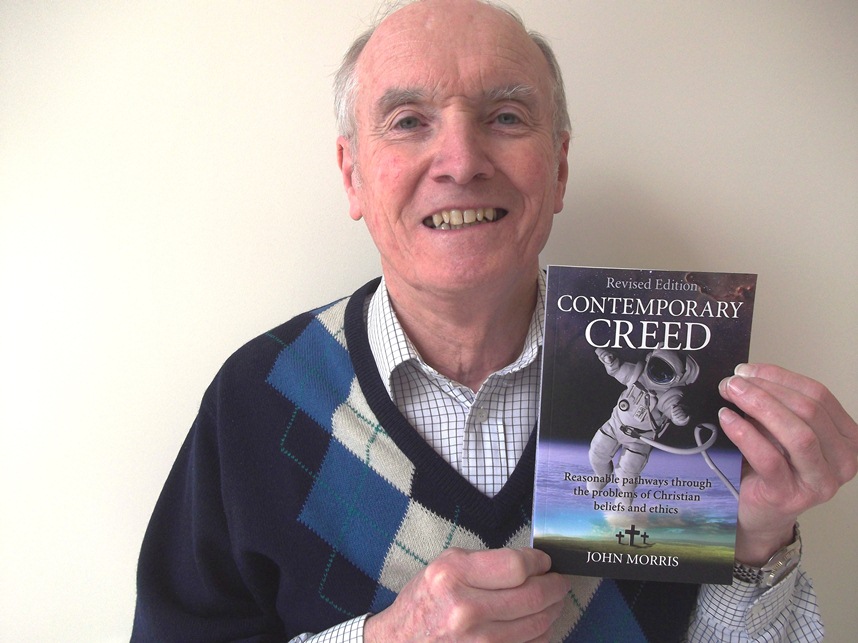
AUTHOR: John Morris, MA, M.Ed, PGCE, PhD, was a teacher and lecturer for over thirty years before being ordained as an unpaid Anglican clergyman in 1995. |
Back Cover Endorsements
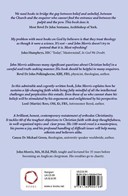
| We need books to bridge the gap between belief and unbelief, between the Church and the enquirer who cannot find the entrance and, for that matter, between the pulpit and the pew. This book does it... John Morris taught me when I was a young man ... (see p14 for full text) |
| My problem with most books on God by believers is that they treat theology as though it were a science. It's not - and John Morris doesn't try to pretend that it is . Most refreshing! |
| John Morris addresses many significant questions about Christina belief in a careful and truth-seeking manner. His book should be helpful to many enquirers. |
| In this admirable and cogently-written book, John Morris explains how he sustains a life-changing faith while being fully mindful of all the intellectual challenges and preplexities this entails. Even those of us who cannot share his beliefs will be stimulated by his arguments and enlightened by his perspective. |
| A brilliant, honest, contemporary restatement of orthodox Christianity. It tackles 60 of the toughest objections to Christian faith with deep thoughtfulness, in well-organised topics and clear prose. His 100-word creed is a masterpiece, his poems a joy, and his profound handling of difficult issues will help many, atheists and believers alike. |
|
Equipment for Disabled Children Friends of Albella Boys Home, Darjeeling |
Home | Purpose of the Book | Reviews of the Book | Free Read of the Book | To Buy the Book
New Book Suffering | Biography of author | Articles by John Morris